Tradition to Tech: Why Japan Is Opening Its Doors to Global Professionals

🌏 Japan: The Emerging Hub for Global Skilled Talent
🏁 Introduction
In today’s interconnected world, innovation and cross-cultural collaboration have become the driving forces of economic growth. Among the countries leading this global transformation stands Japan — a nation renowned for its technological precision, discipline, and pursuit of excellence.
However, Japan now faces a defining moment. With a rapidly aging population and a declining birth rate, the country’s workforce is shrinking. To sustain its economy and uphold its reputation as a technological powerhouse, Japan is strategically opening its doors to skilled professionals worldwide.
This marks a historic shift from its traditionally insular employment practices toward an inclusive, globally integrated model. Japan is not just inviting talent — it is welcoming a new era of collaboration and shared progress.

📊 Japan’s Changing Workforce Dynamics
For decades, Japan’s employment structure was built on the principle of lifetime employment — employees joined a company after graduation and remained loyal until retirement. While this ensured stability and trust, it also limited flexibility and global integration.
Today, with the workforce shrinking, the Japanese government is introducing progressive policies to attract international professionals.
| Workforce Challenges | Government Response |
| Aging population (28% over 65 years) | Bilateral agreements with India, Vietnam, Indonesia, etc. |
| Labor shortage in manufacturing, IT, and healthcare | Skill-specific visa categories for global professionals |
| Decline in local engineering graduates | METI and university-led internship programs |
This shift aims not only to fill vacancies but also to infuse diverse perspectives and creativity into Japan’s economy, ensuring long-term sustainability.
🧠 The Demand for Technically Skilled and Culturally Aware Professionals
In the past, fluency in Japanese was considered more important than technical mastery. However, the new professional landscape prioritizes skill and mindset over linguistic perfection.
Japanese employers now seek candidates who combine:
Technical Excellence – Strong background in AI, robotics, electronics, data science, or mechanical engineering.
Basic Communication Skills – Enough Japanese to collaborate effectively in teams.
Cultural Adaptability – Respect for discipline, teamwork, and responsibility.
Growth Mindset – A willingness to learn continuously out of genuine interest.
“Skills may open the door, but sincerity earns you trust — the true currency of success in Japan.”

💡 Expectations from International Professionals
Japanese organizations operate on the philosophy of kaizen (continuous improvement) and collective harmony. To thrive in this environment, global professionals must understand and embrace certain principles.
| Key Traits Expected | What It Means |
| Respect & Discipline | Following etiquette, punctuality, and humility |
| Team Collaboration | Working harmoniously without excessive individualism |
| Initiative with Humility | Suggesting ideas while respecting hierarchy |
| Long-term Commitment | Viewing work as a craft, not just a paycheck |
The Japanese workplace values consistency and character as much as technical expertise. International employees who respect this balance often find themselves progressing faster and more meaningfully.
💼 Global Internship and Training Opportunities in Japan
Japan offers structured pathways for students and professionals to experience its corporate culture through internships and research programs. These programs bridge academic theory with practical exposure.
| Program Name | Organized By | Focus Area | Benefits |
| METI Government Internship (2025) | Ministry of Economy, Trade & Industry | Industry training & innovation | Global work experience, networking |
| OIST Research Internship | Okinawa Institute of Science & Technology | Science and research | Fully funded, mentorship with top scientists |
| HENNGE Global Internship | HENNGE K.K., Tokyo | IT & software development | Hands-on tech projects, cross-cultural collaboration |
| UTSIP Kashiwa (University of Tokyo) | University of Tokyo | Research & innovation | Academic excellence, lab exposure |
| CRCC Asia – Global Internship Program | CRCC Asia | Business, Engineering, Marketing | Industry experience in Tokyo |
Each of these initiatives helps participants not only sharpen their professional skills but also immerse themselves in Japanese culture, preparing them for long-term success.

🏭 Key Sectors Opening for Global Professionals
Japan is actively inviting talent into high-demand sectors that require both innovation and problem-solving.
| Sector | Opportunities | Required Skills |
| Robotics & Automation | System design, control systems | Mechatronics, AI |
| Semiconductor & VLSI | Chip design, embedded systems | VHDL, Verilog, IoT |
| Renewable Energy | Smart grids, green tech | Power electronics, sustainability |
| Healthcare Tech | AI diagnosis, medical IoT | Data science, biomedical engineering |
| Software & AI | App development, ML research | Python, cloud computing |
Each field blends Japan’s engineering discipline with the creativity of global thinkers.
🏮 Why Japan Is a Game-Changer for Global Talent
| Opportunity Area | What Makes It Unique |
| Innovation & Technology | Home to pioneers in robotics, automation, and AI |
| Cultural Balance | Combines discipline with creativity |
| Work-Life Quality | Safe, clean, respectful environment |
| Long-Term Career Growth | Trust-based employer–employee relationships |
| Global Recognition | Experience in Japan adds value worldwide |
Working in Japan refines not just your career, but your character.
🌐 Japan’s Future Vision: Society 5.0
Japan’s development is guided by the futuristic concept of Society 5.0 — a model that aims to integrate physical and digital spaces seamlessly.
Society 5.0 envisions a world where technology enhances human life through AI-driven innovation, smart cities, sustainable energy, and human-centric design.
| Key Pillars of Society 5.0 | Description |
| Smart Infrastructure | AI and IoT integration in transportation and housing |
| Healthcare Technology | Robotics and data science for elderly care |
| Green Innovation | Renewable energy and eco-friendly systems |
| Digital Transformation (DX) | Cloud-based automation and smart manufacturing |
Foreign professionals — especially in engineering, AI, and sustainability — will play a crucial role in realizing this vision.

✈️ How You Can Prepare to Work in Japan
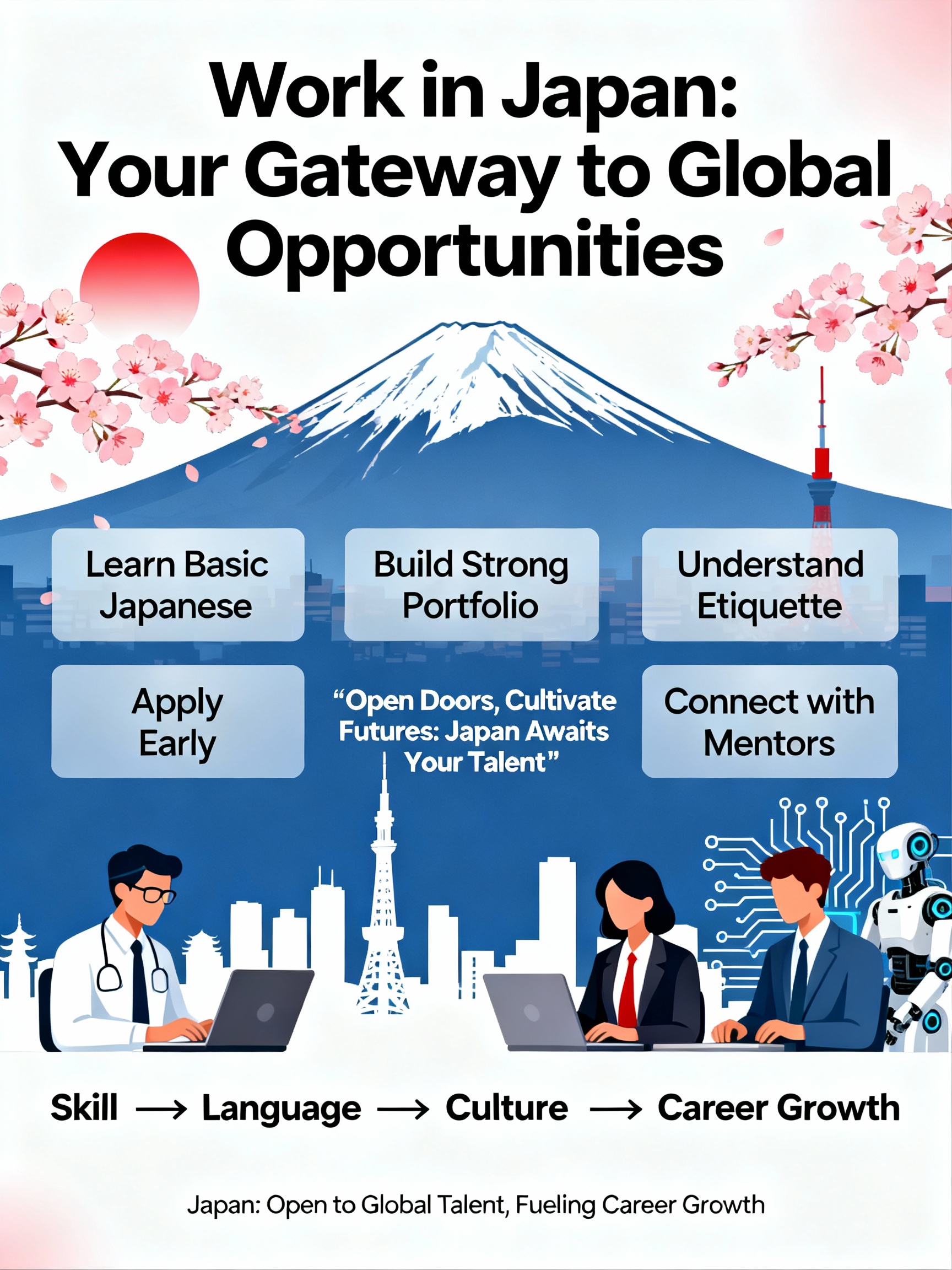
Learn Basic Japanese (JLPT N4 or N3) – Enough for workplace communication.
Build a Strong Portfolio – Highlight hands-on projects, research, or internships.
Understand Japanese Etiquette – Bowing, punctuality, teamwork, and silence are forms of respect.
Apply Early for Internships – Many open 6–8 months in advance.
Connect with Alumni or Mentors – Join communities of professionals already working in Japan.
🚀 Japan’s Global Message: A Door Wide Open
Japan’s message to the world is clear and inspiring:
“We welcome those who bring ability, respect, and curiosity.”
This sentiment reflects a profound evolution — from a closed economy to one that values diversity and innovation.
Building a career in Japan means:
Contributing to a culture of precision and progress.
Experiencing the fusion of tradition and technology.
Growing in an environment that prizes both discipline and creativity.
Why Japan Is Ideal for Global Talent
Strong demand for STEM and IT professionals.
Government-supported visa and internship programs.
Respect-driven work environments.
Opportunity to experience one of the world’s most advanced societies.
🏆 Conclusion
Japan’s transformation into a global hub for skilled professionals is not merely a response to demographic change — it is a vision for the future.
The nation’s industries, from robotics to research, are being strengthened by international collaboration and innovation. For students and professionals who possess both technical excellence and cultural intelligence, Japan offers an unparalleled stage to grow, contribute, and lead.
For many, a journey to Japan is more than a career move — it’s an invitation to be part of a culture where discipline meets innovation and dedication leads to excellence.
In the land of rising opportunities, your skills can shine the brightest.

